




$33 Billion Natural Gas Megaplant Proposed for Southern Ohio Under U.S.–Japan Deal
Trump administration-backed project could become the largest of its kind in U.S. history
NEWS
Miranda Morrow
4/13/20262 min read
By Miranda Morrow
April 2026
ATHENS, Ohio — A massive natural gas power plant proposed for southern Ohio is drawing national attention as part of a sweeping U.S.–Japan investment agreement, with supporters touting economic growth and critics raising questions about feasibility and long-term impacts.
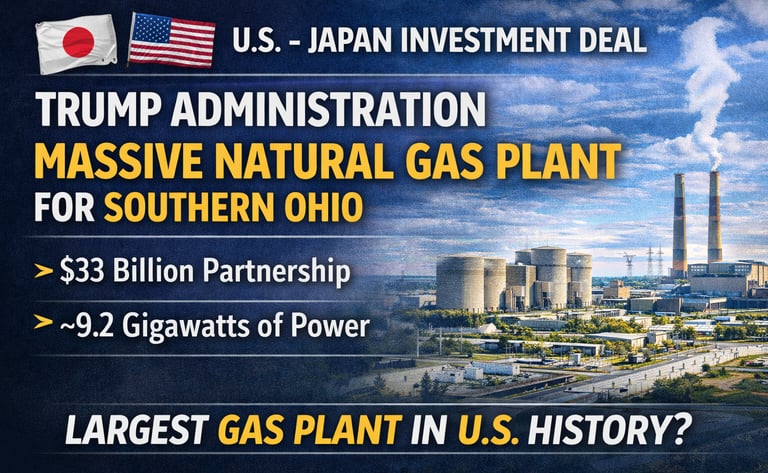
The project, announced by the Trump administration in February, would bring a $33 billion natural gas-fired power facility to the Portsmouth region—potentially becoming the largest of its kind in the United States.
A Power Plant on an Unprecedented Scale
According to federal officials, the proposed plant would generate approximately 9.2 gigawatts of electricity, a level comparable to the output of several nuclear reactors combined.
At full capacity, the facility could produce enough power to supply millions of homes across the PJM regional grid, positioning Ohio as a central player in meeting rising electricity demand driven by manufacturing and artificial intelligence.
The project is expected to be developed and operated by SB Energy, a subsidiary of Japan’s SoftBank Group, as part of a broader economic partnership between the United States and Japan.
Part of a Broader Strategic Investment
The Ohio plant represents the largest component of an initial $36 billion investment package tied to a wider $550 billion U.S.–Japan trade and investment agreement.
Other projects included in the first wave of funding involve energy infrastructure in Texas and advanced manufacturing in Georgia, reflecting a coordinated effort to strengthen industrial capacity and energy security.
Federal officials have framed the Ohio facility as a cornerstone project designed to:
Expand baseload power generation
Support domestic manufacturing
Meet surging energy demand from data centers and advanced computing
Local Reaction: Opportunity and Uncertainty
In southeastern Ohio, where economic development opportunities have been limited for decades, the announcement has been met with cautious optimism.
Local leaders say the project could attract new industries and reduce strain on existing infrastructure if paired with additional development, including data centers.
However, many details remain unclear.
Officials have yet to confirm:
The exact location of the facility
A construction timeline
How the plant will connect to the regional grid
The full financing structure
That uncertainty has led some observers to question whether the project can move forward as quickly—or as smoothly—as envisioned.
Challenges Ahead
Energy analysts point to significant hurdles that could shape the project’s future.
Large-scale gas plants typically face:
Lengthy permitting processes
Supply chain constraints for turbines and equipment
Grid interconnection delays that can take years
Additionally, the project’s sheer cost raises questions about how electricity pricing and infrastructure expenses will be managed over time.
Some critics have also raised environmental and public health concerns, particularly given the region’s history with industrial activity and ongoing site remediation efforts.
Tied to a Larger Transformation
The proposed plant is not an isolated project. It is closely connected to a broader push to transform southern Ohio into a hub for energy and advanced computing.
Federal officials have already announced plans to redevelop nearby land—once used for uranium enrichment—into a major technology campus combining data centers with large-scale power generation.
Together, these efforts signal a shift in how infrastructure is being planned: pairing massive computing demand with equally large, dedicated energy supply.
What Comes Next
While the announcement marks a significant step, the project remains in early development.
Further details are expected as federal agencies, state officials, and private partners move forward with planning, regulatory approvals, and financing arrangements.
For now, the proposal stands as one of the most ambitious energy projects ever contemplated in Ohio—one that could reshape the region’s economic future, if it can overcome the challenges ahead.