




Meta Deal Secures Future of Ohio Nuclear Plants
Long-term agreement with Vistra keeps Davis-Besse and Perry operating for decades
NEWSECONOMICS
4/13/20262 min read
By Nancy Carrington
April 12, 2026
CLEVELAND — Two of Ohio’s most prominent nuclear power plants, once facing uncertain futures, are now positioned to operate for decades longer following a major long-term energy agreement between Meta Platforms and Vistra Corp.
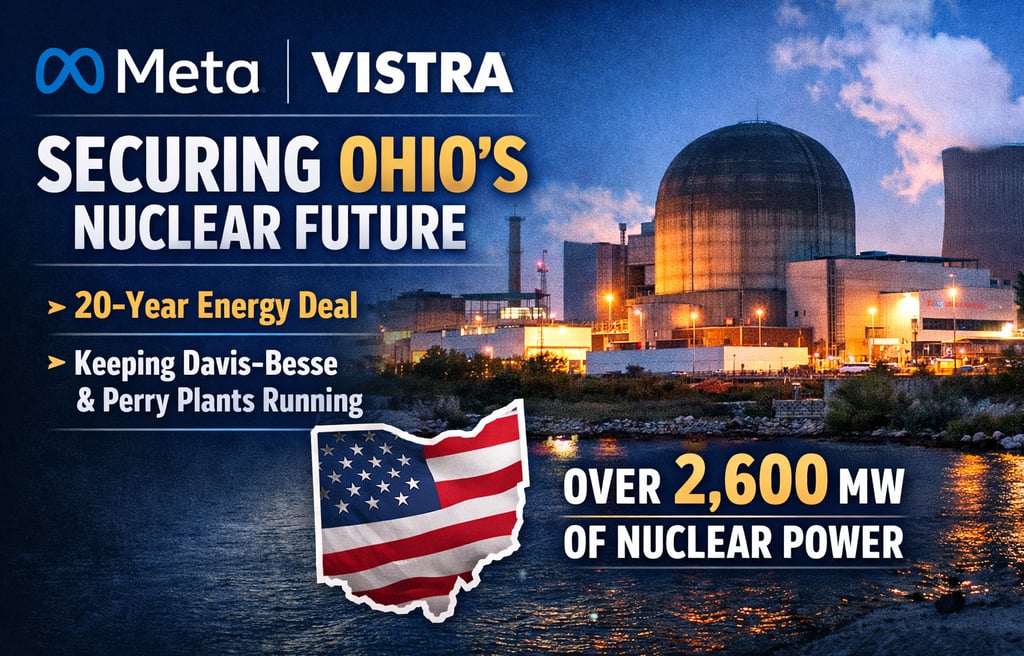
The deal, announced earlier this year, commits Meta to purchasing more than 2,600 megawatts of nuclear-generated electricity from Vistra’s facilities, including the Davis-Besse plant near Oak Harbor and the Perry plant along Lake Erie.
The agreement spans 20 years and is expected to stabilize operations at both sites while supporting upgrades that will increase their generating capacity.
From Uncertainty to Stability
Just a few years ago, both Davis-Besse and Perry were considered at risk of early retirement due to economic pressures facing nuclear energy. That outlook changed after Vistra acquired the plants through its 2024 purchase of Energy Harbor.
The newly announced agreement with Meta provides the financial backing needed to keep the plants running, preserve thousands of jobs, and maintain a steady stream of tax revenue for local communities.
“This is a significant shift,” said industry analysts following the deal. “These plants went from being on the edge of closure to becoming central assets in powering the next generation of technology.”
Powering the Digital Economy
The agreement reflects a growing demand for reliable, around-the-clock electricity as major technology companies expand their data centers and artificial intelligence operations.
Meta, the parent company of Facebook and Instagram, has increasingly sought stable energy sources to support its rapidly growing computing infrastructure. Nuclear power, which operates continuously and is not dependent on weather conditions, has emerged as a key part of that strategy.
Under the agreement, electricity from Davis-Besse and Perry will not be sent directly to Meta facilities. Instead, it will flow into the regional PJM power grid, helping meet overall demand while indirectly supporting Meta’s energy needs.
Expanding Capacity and Extending Lifespans
The deal includes not only the continued operation of existing reactors but also plans to increase output through equipment upgrades. These improvements are expected to add more than 400 megawatts of additional capacity across the plants by the early 2030s.
Vistra is also expected to pursue license renewals that could extend the operational lives of Davis-Besse and Perry well beyond their current expiration dates—potentially into the 2050s.
Currently, Davis-Besse is licensed to operate through 2037, while Perry is licensed through 2046.
Local Impact
For communities surrounding the plants, the agreement provides long-term economic security.
The facilities employ hundreds of workers directly and support additional jobs through contractors and local businesses. They also contribute significant tax revenue that helps fund schools, emergency services, and infrastructure.
Local officials have welcomed the development, noting that the plants remain among the largest economic drivers in their respective regions.
A Broader Trend
The Meta–Vistra agreement is part of a larger movement among technology companies to secure dependable energy supplies as digital infrastructure expands.
As artificial intelligence and data processing demands continue to grow, energy-intensive industries are increasingly turning to nuclear power for its reliability and scale.
For Ohio, the agreement ensures that two long-standing power stations—once considered part of the past—will play a central role in the state’s energy future.
“These plants were built for a different era,” one energy expert noted. “But it turns out they’re exactly what this era needs.”