




SoftBank Targets Southern Ohio for Massive AI Data Center Hub
Former nuclear site could become one of the largest technology and energy complexes in the world
NEWSECONOMICS
Miranda Morrow
4/13/20262 min read
By Miranda Morrow
April 12, 2026
PIKETON, Ohio — A quiet stretch of southern Ohio once tied to the nation’s Cold War nuclear program is now at the center of one of the most ambitious technology infrastructure projects ever proposed in the United States.
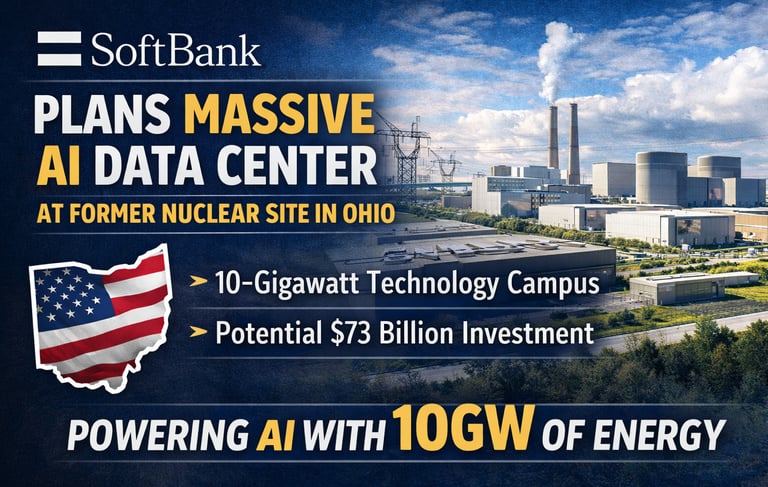
SoftBank Group, through its subsidiary SB Energy, is planning a 10-gigawatt data center campus at the former Portsmouth Gaseous Diffusion Plant site in Pike County—an undertaking that could transform the region into a national hub for artificial intelligence and energy production.
A Project of Unprecedented Scale
The proposed development is staggering in size.
At full buildout, the data center alone would require 10 gigawatts of electricity, placing it among the largest facilities of its kind in the world.
To meet that demand, SB Energy plans to construct an equivalent amount of new power generation capacity—including approximately 9.2 gigawatts from natural gas plants—alongside major transmission upgrades across southern Ohio.
The energy infrastructure component carries an estimated price tag of more than $33 billion, part of a broader U.S.–Japan investment agreement.
Meanwhile, the data center itself could require an additional $30 billion to $40 billion in investment.
From Uranium Enrichment to Artificial Intelligence
The site selected for the project carries deep historical significance.
The Portsmouth facility began operations in the 1950s, enriching uranium for national defense and later for civilian nuclear power. Operations ceased in 2001, and the site has since been undergoing long-term environmental cleanup.
Now, federal officials are partnering with SoftBank and AEP Ohio to redevelop the land into what is being called the PORTS Technology Campus—a multi-use complex centered on energy and advanced computing.
Officials say the site’s existing high-capacity transmission infrastructure made it an attractive location for the project.
Economic Impact and Job Creation
The project is expected to deliver a significant economic boost to the region.
Initial plans call for:
An 800-megawatt first phase of the data center
Roughly 4,000 construction jobs during early development
Between 300 and 400 permanent jobs once operational
At full scale, estimates suggest the project could expand to tens of thousands of construction workers and thousands of long-term positions.
Local officials have described the development as a potential “generational change” for a region that has faced decades of economic challenges.
Energy, AI, and National Strategy
The initiative reflects a broader shift in how large-scale data centers are being developed.
Rather than relying solely on existing grid capacity, the SoftBank project pairs dedicated power generation, transmission infrastructure, and computing facilities in a single integrated system—a model designed to avoid delays and ensure reliable energy supply.
Federal officials have framed the project as part of a strategic effort to:
Strengthen U.S. competitiveness in artificial intelligence
Expand domestic energy infrastructure
Reduce reliance on foreign supply chains
Questions and Concerns Remain
Despite the optimism, the project is not without controversy.
The Portsmouth site is still undergoing environmental remediation, and concerns have been raised about building large-scale infrastructure on land with a history of contamination.
Additionally, some residents and advocacy groups have questioned the long-term impact of massive data center developments on local communities, infrastructure, and energy systems.
Looking Ahead
Construction on the project is expected to begin later this year, with the first phase of the data center potentially coming online within two years.
If completed as planned, the PORTS Technology Campus would stand as one of the largest combined energy and computing developments ever built—linking Ohio’s industrial past with the rapidly expanding demands of the digital age.
For Pike County, it marks a dramatic transformation: from enriching uranium for national defense to powering the next generation of artificial intelligence.